Webshop fulfilment before the carrier cut-off
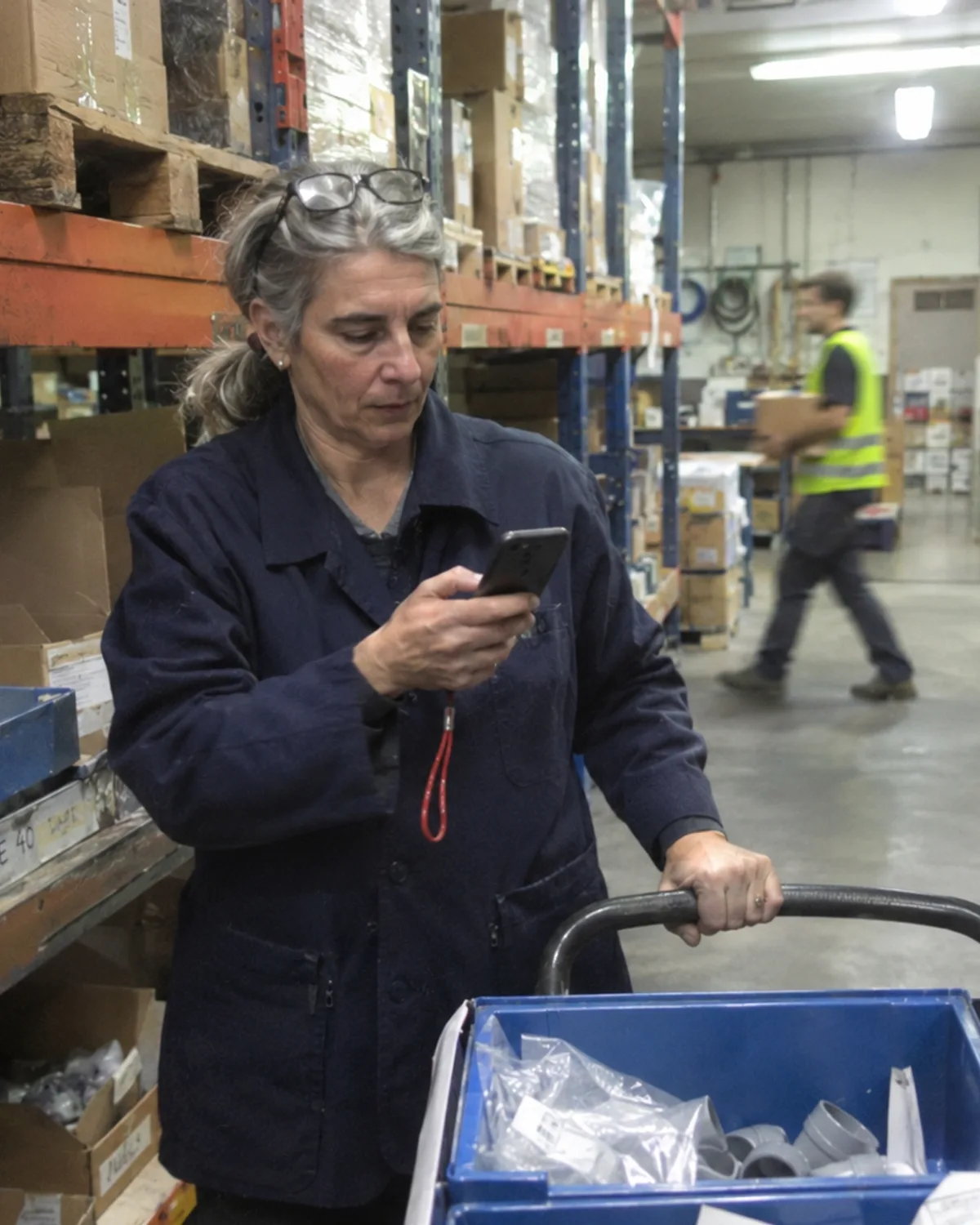
Orders received before the afternoon cut-off are batched by zone, picked into totes and packed with labels printed automatically, so the van leaves with everything that was paid that day.
Warehouse & logistics· SME warehouses, 3PLs and e-commerce fulfilment
Receiving, putaway, picking, packing and counts on scanners or phones, with stock by location you can trust.
We build a WMS around the way your warehouse actually moves goods: how trucks are received, where pallets go, how orders are released to pickers and how parcels leave the dock. It starts from a warehouse base we have already built and tested (locations, stock movements, scanning, picking logic), then we adapt it to your layout, your clients and your ERP or webshop. You get a first production release in weeks, without a multi-year ERP rollout.
Built to measure for SME warehouses, 3PLs and e-commerce fulfilment, starting from a proven base we have already developed and tested.
The problem
Many SME warehouses run on the stock module of the ERP or webshop, plus spreadsheets and the memory of two experienced people. The ERP knows that 40 cartons exist; it does not know they sit on three different shelves, one of them in the overflow area behind the dock. When the experienced picker is on holiday, the warehouse slows down.
Enterprise WMS suites solve this, but they arrive with long projects, licence fees per scanner and processes designed for distribution centres ten times your size. Third-party logistics providers have an extra problem: every client sends orders in a different format and expects its own stock report.
The solution
The WMS keeps stock by location, not only by item. Each pallet, carton or unit is received against a purchase order or advance shipping notice, put away to a suggested bin, picked with a scan and confirmed at packing. Office staff see what is on each shelf, what is reserved and what is in transit inside the building.
Orders flow in from your ERP, webshop or 3PL clients, are grouped into waves or batches, and are released to pickers on handheld scanners or Android phones. Packing stations print the carrier label, and the shipment status goes back to the system that created the order. Cycle counts run in small slots during the week instead of one long stocktake.
Built to measure for SME warehouses, 3PLs and e-commerce fulfilment, starting from a proven base we have already developed and tested.
First release in 6-10 weeks · From €4,990 excl. VAT
Features
Scan incoming cartons against the expected purchase order or advance shipping notice, record over, short and damaged quantities, and capture lot, serial and expiry at the dock.
The scanner proposes a destination bin based on rules you define: fixed pick face, zone, product family, free capacity or the bin that already holds the same lot.
Release orders one by one, combine small orders into a batch for one picker, or plan waves by carrier cut-off time, zone or client. Pick lists follow the walking sequence of your locations.
Allocation picks the lot with the earliest expiry first, or follows FIFO where dates do not matter, and blocks lots that are on hold or too close to expiry for a given customer.
Scan items into the parcel, check weight, choose the box and print the carrier label and packing slip in one step, then send tracking numbers back to the order source.
Schedule counts by zone, by fast movers or by bins with discrepancies, count with a scanner during normal operations and approve corrections with a reason code.
Keep stock, orders, item masters and reports separated per 3PL client, with client-specific rules for packing, labelling and lot handling.
Generate replenishment tasks from reserve to pick face when stock drops below a minimum, and log every internal move with user and time.
Orders by status, lines picked per hour, open receipts, count discrepancies and orders at risk of missing the carrier cut-off, on one screen for the shift lead.
In practice
A purchase order or ASN arrives from the ERP or from the 3PL client and appears as an expected delivery for the dock team.
The truck is unloaded, cartons are scanned and checked, lot and expiry are captured, and pallets are put away to the bins the scanner suggests.
Orders from the webshop, ERP or clients are allocated to stock with FEFO rules and released as single orders, batches or waves.
Pickers follow the scanner route and confirm each location; at the packing station the parcel is checked, weighed and labelled.
Parcels and pallets are loaded by carrier, tracking numbers and shipped quantities return to the order source, and stock updates in real time.
Integrations
Exchange items, purchase orders, sales orders and stock levels with ERP systems such as Microsoft Dynamics 365 Business Central, Odoo or SAP Business One, through their APIs.
Import orders and push stock and tracking numbers to Shopify, WooCommerce, Magento or marketplaces where an API is available.
Print labels and get tracking from carriers such as DHL, UPS, DPD or GLS, directly or through a shipping platform like Sendcloud, where your contract allows it.
Receive orders and ASNs by API, SFTP or CSV files from each client, and send back shipment confirmations and stock reports in their format.
Works on Android handhelds from vendors such as Zebra or Honeywell, on ordinary Android phones, and with thermal label printers using ZPL.
Integrations depend on the APIs or exports your current tools provide. We verify them during analysis.
Technical sheet
Orders received before the afternoon cut-off are batched by zone, picked into totes and packed with labels printed automatically, so the van leaves with everything that was paid that day.
A new client sends its item master and first ASN as a file; the WMS creates a separate stock account, its own packing rules and a weekly stock report without changes to the code.
Lots close to expiry are blocked for customers with longer shelf-life requirements and offered first to the others, and the dashboard lists them before they become write-offs.
The project
A working session on your current process, data and tools. You receive a written scope, milestones and a fixed quote.
We adapt the proven base to your workflow and deliver a first version your team can use on real data.
Short feedback cycles with the people who use the software, with clear acceptance checks for each milestone.
Data import, training and production release, with the team that built the software on hand.
Fixes and adjustments in the first weeks, then optional ongoing support or new features as separate, scoped iterations.
Price
From €4,990 excl. VAT
First release in 6-10 weeks
Starting price excl. VAT for a first production release. The final price depends on your specifications (integrations, modules, sites, users) and is confirmed in writing before work starts.
We work to agreed milestones and acceptance checks. If we miss a committed delivery, we correct the work on our side until it meets what we agreed.
Request a quoteNo. It is a warehouse system built for your building and your clients, starting from a WMS base we have already written and tested (locations, stock movements, scanning, picking logic). We then configure your layout, putaway rules, picking methods and integrations. No per-device licence fees for a standard package, and the ERP keeps purchasing, invoicing and accounting.
A first production release for a single warehouse: locations, receiving, putaway, picking, packing, counts, one integration with your ERP or webshop and one carrier connection, plus data import and training. Multiple sites, 3PL billing, extra integrations or special picking methods increase the scope. We agree scope and price in writing before work starts. Prices exclude VAT.
Not necessarily. The scanner app runs on rugged Android handhelds, which are best for high-volume picking, but also on ordinary Android phones with a camera or a Bluetooth ring scanner. Many warehouses start with a mix and upgrade the busiest roles later.
We import items, units and locations from your ERP or spreadsheets, then do an opening count per zone with the scanners just before go-live. That count becomes the starting stock by location. We plan it with you so it fits a weekend or a quiet day.
Yes. Each client has its own stock, items, order channels and reports, and can have its own rules for lot handling, packaging and labels. A read-only portal or a scheduled report lets each client see only its own stock and shipments.
We check coverage during the walkthrough. The scanner app can buffer scans for short interruptions and send them when the connection returns; for areas with no signal at all we usually recommend improving coverage, because real-time stock depends on it.
Phone-camera scanning, stock in and out, transfers between shop, stockroom, vans and sites, quick counts, low-stock alerts and reorder lists.
Transport orders, planning board by truck, trailer and driver, subcontracting to partner carriers, CMR and POD, trip costing and invoicing.
Two-way sync between your online store, marketplaces and ERP: products, stock per warehouse, customer prices, orders, invoices, tracking and returns.
A few lines are enough. We reply within one business day with questions and a first view of scope and cost.
From €4,990 excl. VAT · First release in 6-10 weeks
Tell us how you work today and which tools you use. We reply with a concrete first release proposal, a timeline and a price.