Energy and compressed air per line
Modbus energy meters and flow sensors are read every few seconds and stored per line, so consumption can be compared with output from the production orders.
Industrial software· Manufacturers, machine builders and automation teams
Edge gateways, protocol connectors and retrofit sensors that turn PLC signals into clean, stored and documented production data.
Before any dashboard, MES or analysis tool can be trusted, the data has to arrive: complete, time-stamped and named the same way for every machine. We build that layer for your plant, starting from a gateway and connector base we have already built and tested, and adapt it to your controllers, your network rules and the systems that will consume the data.
Built to measure for manufacturers, machine builders and automation teams, starting from a proven base we have already developed and tested.
The problem
Most plants own a mix of controllers from different decades and vendors: a Siemens S7-1500 on the new line, an S7-300 on the old one, a Beckhoff PC on a special machine, a Modbus energy meter on the compressor, and a few machines with no interface at all. Each project that needed data so far solved it once, with its own script or a vendor tool, and nobody remembers how it works.
The result is fragile point-to-point links. When the network drops for ten minutes, values are lost. When a PLC program changes, a tag address shifts and a report quietly shows zeros. And when IT asks who can reach the machine network from outside, the honest answer is often "not sure".
The solution
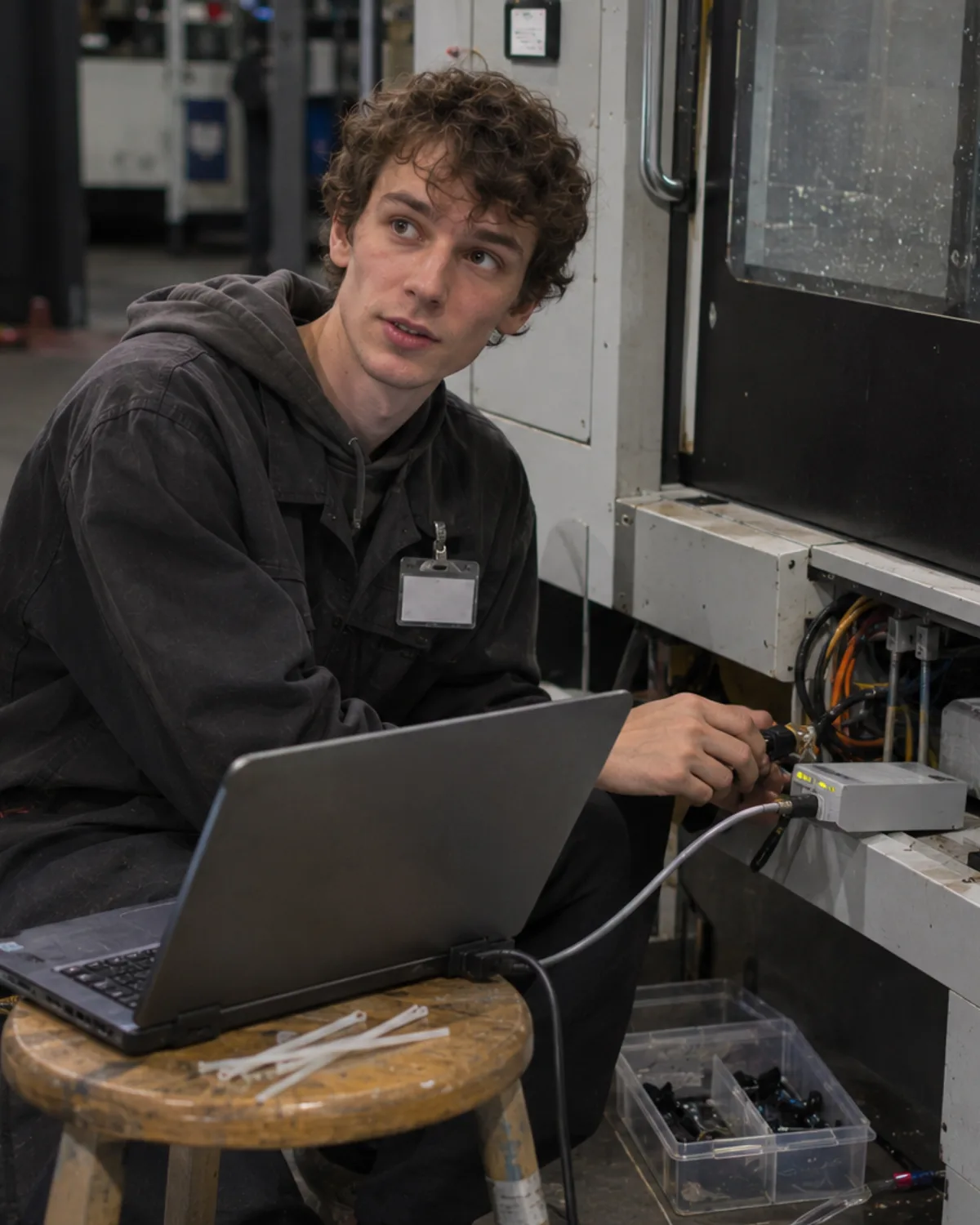
We install edge gateway software close to the machines, on an industrial PC or a small server in the plant network. It talks to each controller in its own protocol, reads the agreed signals at the agreed rate, and maps them to a clear model: site, area, line, machine, signal, unit. Older machines get retrofit sensors so they join the same model.
Values are buffered on the gateway when the upstream link is down and forwarded in order when it returns. They are stored in a time-series database, checked against alarm rules, and published to consumers through documented data contracts, so your MES, ERP or BI tool reads stable names instead of PLC addresses.
Built to measure for manufacturers, machine builders and automation teams, starting from a proven base we have already developed and tested.
First release in 6-10 weeks · From €4,990 excl. VAT
Features
Drivers for OPC UA, Modbus TCP and RTU, MQTT, Siemens S7, Beckhoff ADS and Rockwell EtherNet/IP, configured per machine with polling rate, deadband and data type.
A small, supervised service on an industrial PC or virtual machine in the plant, with remote configuration through the central application and local logs for troubleshooting.
Stack-light, current, vibration, temperature or pulse sensors on machines without a usable controller, wired to an I/O module or wireless node and mapped like any other signal.
When the link to the server drops, the gateway keeps writing to local disk and sends the backlog in time order once the connection is back, so gaps stay visible and short.
Raw and aggregated values kept in InfluxDB or TimescaleDB with retention rules per signal type, for example raw for months and hourly averages for years.
Rules on values, rates of change or missing data (a signal that has not updated in five minutes) that notify maintenance or the process engineer.
A plant model of sites, lines, machines and signals with units and descriptions, so a tag like DB10.DBD4 becomes Line2/Press3/HydraulicPressure in bar.
Versioned definitions of what each consumer receives (fields, units, frequency), exposed through REST API, MQTT topics or SQL views, so changes are announced instead of discovered.
Status of each gateway, connector and signal: last value, update age, buffer size and error count, for the people who keep the system running.
In practice
We list controllers, firmware, available interfaces and the current network layout with your maintenance and IT staff.
For each machine we agree which signals matter, their sample rate and their names in the plant model, based on what the consuming systems need.
The gateway is installed in the OT network, connectors are configured and tested machine by machine, retrofit sensors are mounted where needed.
Data flows into the time-series database, alarm rules are activated and the first consumer (a dashboard, the ERP or BI) reads through its contract.
Your team receives documentation of the model and connectors, and new machines are added following the same pattern.
Integrations
Siemens S7 (including older S7-300/400), Beckhoff TwinCAT via ADS, Rockwell via EtherNet/IP, and any controller with an OPC UA server or Modbus interface.
Publishing to an existing broker such as Mosquitto, EMQX or HiveMQ, with a topic structure that follows your plant model.
InfluxDB or TimescaleDB as the store, with Grafana available for engineers who want their own trend views.
Counters, states and consumption values delivered to SAP Business One, Microsoft Dynamics 365 Business Central, Odoo or an existing MES through APIs or database views.
SQL views or exports prepared for Power BI or similar tools, with stable column names and units.
Integrations depend on the APIs or exports your current tools provide. We verify them during analysis.
Technical sheet
Modbus energy meters and flow sensors are read every few seconds and stored per line, so consumption can be compared with output from the production orders.
Temperatures, pressures and cycle times stored with timestamps let quality engineers look back at what the machine was doing when a defective batch was produced.
An old data logger on a single PC is replaced by a supervised gateway with buffering, a documented model and an API, without changing the PLC program.
The project
A working session on your current process, data and tools. You receive a written scope, milestones and a fixed quote.
We adapt the proven base to your workflow and deliver a first version your team can use on real data.
Short feedback cycles with the people who use the software, with clear acceptance checks for each milestone.
Data import, training and production release, with the team that built the software on hand.
Fixes and adjustments in the first weeks, then optional ongoing support or new features as separate, scoped iterations.
Price
From €4,990 excl. VAT
First release in 6-10 weeks
Starting price excl. VAT for a first production release. The final price depends on your specifications (integrations, modules, sites, users) and is confirmed in writing before work starts.
We work to agreed milestones and acceptance checks. If we miss a committed delivery, we correct the work on our side until it meets what we agreed.
Request a quoteNo. It is a connectivity layer built for your plant from components we have already developed and tested: gateway service, protocol connectors, buffering and the central configuration app. We adapt it to your controllers and consumers. You do not pay per tag or per device, and the system runs where your IT policy says it should.
A first production release for an agreed set of machines: gateway, connectors, data model, time-series storage, buffering, basic alarm rules and one data contract, with documentation. The final price depends on the number and types of controllers, retrofit sensors and consumers. Scope and price are fixed in writing beforehand, excl. VAT, hardware separate.
Usually not. We read existing data blocks, OPC UA nodes or Modbus registers. If a value does not exist in the PLC, your machine builder or integrator can expose it, or we add a retrofit sensor. Write access to PLCs is disabled unless explicitly agreed.
The gateway sits in the OT network and only opens outbound, encrypted connections. Nothing on the internet can reach the machines. We work with your IT on segmentation and firewall rules and document every connection, using IEC 62443 zone and conduit principles as a reference.
The gateway keeps reading and writes values to local storage. When the connection returns, it sends the backlog in order. Buffer size is set according to how long an outage you want to bridge.
The layer can provide the machine-to-system interconnection those schemes describe. Eligibility of an investment is assessed by your advisor or technical expert; we supply technical documentation of how data is exchanged.
Live machine states, OEE per machine and shift, operator downtime reasons, andon screens and automatic shift reports for SME factories.
Lot and serial tracking from goods receipt to dispatch, with barcode labels, batch genealogy, recall simulation and quality data on every lot.
Asset register, preventive maintenance plans, work orders, breakdown requests and spare parts for plants, facilities and maintenance contractors.
A few lines are enough. We reply within one business day with questions and a first view of scope and cost.
From €4,990 excl. VAT · First release in 6-10 weeks
Tell us how you work today and which tools you use. We reply with a concrete first release proposal, a timeline and a price.